
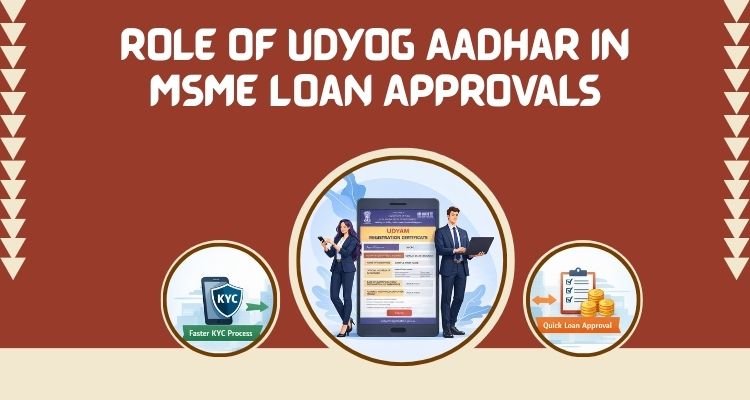
Role of Udyog Aadhar in MSME Loan Approvals
The struggle to secure capital was once the single biggest nightmare for India’s micro-entrepreneurs. Between complex documentation and strict eligibility criteria, the path to a bank loan seemed nearly impossible. To solve this, the Government launched Udyog Aadhaar—effectively a certificate for small business recognition. It replaced a large bundled files with a streamlined digital ID, making it significantly easier for lenders to trust and fund small enterprises. This article explain the Role of Udyog Aadhar in MSME Loan Approval and how udyam / udyog registration played in smoothing the loan approval process and its lasting impact on the credit facilities. Understanding Udyog Aadhaar The 2015 launch of Udyog Aadhaar represented a landmark moment for India’s self-made business class. By ditching the time-consuming legacy systems, the government made “formalization” accessible to everyone. With a simple online filing, an entrepreneur could obtain their UAM, instantly elevating their business from an unorganized unit to a recognized MSME. This official status was more than just a certificate; it was a bridge to the financial world, giving banks the confidence to approve loans and helping small players tap into vital state benefits. Why MSME Recognition Matters for Loan Approvals Before Udyog Aadhaar, small businesses largely operated off-the-record without legitimate standing. Banks typically label such entities as high-risk applicants because: There was no official proof of MSME status Business records were limited or unorganized Financial history was not properly documented Creditworthiness was difficult to assess Udyog Aadhaar solved many of these issues by giving businesses a formal identity. This identity helped banks recognize MSMEs as a separate and supported category, making loan assessment faster and more transparent. Key Role of Udyog Aadhar in MSME Loan Approval Quickly Check how Udyog Aadhar plays a key role in helping MSMEs to get MSME Loan Approval Quickly: 1. Official Proof of Business Existence One of the biggest advantages of Udyog Aadhaar was that it acted as a government-recognized proof of business. When MSMEs applied for loans, banks could easily verify: Type of business Ownership details Business activity MSME classification (micro, small, or medium) This reduced the need for multiple documents and built trust between lenders and borrowers. 2. Easier Access to Priority Sector Lending The RBI mandates that banks dedicate a specific quota of their credit to the MSME sector through Priority Sector Lending (PSL). Udyog Aadhaar acted as the primary filter for this category. By holding a valid registration, small businesses provided banks with immediate, verifiable proof of eligibility, ensuring they were first in line for these mandatory fund allocations. Loan applications were processed faster Interest rates were often lower Approval chances increased For banks, Udyog Aadhaar simplified compliance with PSL norms, while for MSMEs, it opened doors to better funding opportunities. Documentation Made Easy Udyog Aadhaar replaced piles of files with a single digital certificate. For entrepreneurs, this meant: Instant Recognition: Banks accepted UAM as valid proof of business. Lesser Paperwork: No need for dozens of local certificates. Quicker Processing: Loans moved from “pending” to “approved” much faster. It leveled the playing field for small service providers who didn’t have a formal corporate setup. 4. Improved Credit Assessment Udyog Aadhaar helped banks categorize businesses correctly. Once an MSME was registered: Its size and turnover were clearly defined Business activity was officially recorded Risk assessment became more structured This allowed banks to design loan products specifically for MSMEs, such as working capital loans, term loans, and machinery loans. Unlocking Special Government Funding Udyog Aadhaar served as the essential “entry pass” for various state-sponsored credit initiatives. By holding this registration, MSMEs gained direct access to: CGTMSE: For collateral-free credit security. Mudra & Stand-Up India: For targeted startup and growth capital. PMEGP: For employment-linked subsidies. This registration ensured that small units could secure funding without the burden of providing heavy security or high-interest rates. Udyog Aadhaar’s Influence on Collateral-Free Credit Historically, the absence of high-value security sidelined entrepreneurs from bank financing. Udyog Aadhaar eliminated this bottleneck by: Empowering Capital-Light Funding: Small firms could at last access liquidity without surrendering land or gold as security. Leveraging Government Backing: The registration links businesses to the CGTMSE scheme, where the government acts as the “guarantor” for the loan. Empowering New Visionaries: First-time business owners, who often lack a financial safety net, were given a fair shot at institutional credit. From Idea to Execution: The Udyog Aadhaar Advantage The hardest part of a new business is often the first check. Udyog Aadhaar smoothed the transition from a concept to a funded reality by: Validation at Scale: Providing a universally recognized ID that banks use to verify MSME eligibility instantly. Incentivizing Formal Lending: Making small units attractive to banks through government-linked schemes. Direct Empowerment: Giving the power back to the entrepreneur to handle their own registration and loan applications. This revolutionized the ecosystem, ensuring that “first-timers” had the financial backing to compete in the mainstream market without being burdened by informal debt. Role in Working Capital Loans Working capital is essential for managing daily business expenses such as salaries, rent, raw materials, and utility bills. Banks prefer lending working capital to businesses with clear identification and records. Udyog Aadhaar helped MSMEs: Prove their business legitimacy Show continuity of operations Access overdraft and cash credit facilities This improved liquidity for MSMEs and helped them manage seasonal demand fluctuations. Udyog Aadhaar and Interest Rate Benefits Although interest rates depend on several factors, Udyog Aadhaar indirectly helped MSMEs access loans at competitive rates. Banks often offered: Lower interest rates under the priority sector lending Special MSME loan products Reduced processing fees This made borrowing more affordable and sustainable for small businesses. Digital Integration and Faster Loan Processing Udyog Aadhaar was fully online and digitally integrated with government databases. This digital approach benefited loan approvals by: Enabling quicker verification Reducing manual errors Supporting online loan applications Many banks and NBFCs integrated Udyog Aadhaar data into their loan systems, further speeding up approvals. From Udyog Aadhaar to Udyam Though the Udyam portal launched in July 2020 to revamp the